
In the lobby of
the Peter Bent Brigham Hospital right above the display of Dr. Joseph Murray's
Nobel medal is a quote from him: "Service to society is the rent we pay
for living on this planet." That quote summarizes the measure of the greatness
of the man who died on Thanksgiving night from a hemorrhagic stroke age 93. He devoted his life to the care of transplant patients. Dr. Betsy Nabel, the President of the Brigham and Women's Hospital is quoted as saying: “Dr. Murray opened the doors for hundreds of thousands of people to receive life-saving transplants. To date, more than 600,000 people world-wide have received the gift of life through transplantation.” A quote in the Globe reinforces the humility of the man: "In his endeavors,
colleagues say, Dr. Murray was an unassuming man who handled each patient, no
matter how trivial the malady, with compassion imbued by a quiet sense of
confidence."
Dr. Joseph Murray, was awarded the Nobel Prize in Medicine in 1990, an honor he shared with Dr. E. Donnall Thomas, a pioneer in bone marrow transplants who died a month ago.
Dr. Joseph Murray, was awarded the Nobel Prize in Medicine in 1990, an honor he shared with Dr. E. Donnall Thomas, a pioneer in bone marrow transplants who died a month ago.

Here is his obituary in the Boston Globe and the UK's Daily Telegraph.
Joe Murray was born on April 1, 1919, the son of William A. Murray and Mary DePasquale, and grew up in Milford, Massachusetts. After a period of excellence as a sportsman he attended Harvard Medical School. After graduating from medical school, Murray was a surgical intern at Peter Bent Brigham Hospital before joining the Army Medical Corps in 1944.
In December 1954, Murray performed the world's first successful renal transplant between the identical Herrick twins at the Peter Bent Brigham Hospital (later Brigham and Women's Hospital); he was assisted in this task by J. Hartwell Harrison, M.D. and other physicians. The story of the first kidney transplantation is related here and is also described in an NPR article. John Merrill and Bernie Carpenter, both now deceased, also made major contributions to the transplantation endeavor as a part of Murray's team.
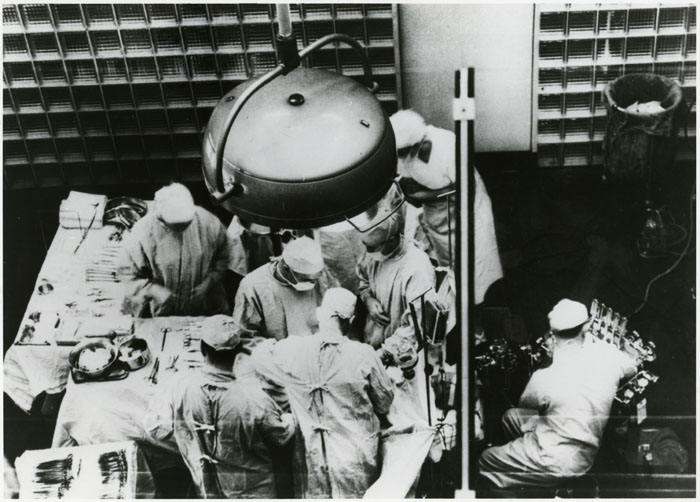
From Wikipedia: "In 1959, Murray performed the world's first successful allograft and, in 1962, the world's first cadaveric renal transplant. Throughout the following years, Murray became an international leader in the study of transplantation biology, the use of immunosuppressive agents, and studies on the mechanisms of rejection. In the 1960s, the discovery of anti-rejection drugs such as azathioprine, imuran and prednisone, allowed Murray to carry out transplants from unrelated donors.
Murray served as chief plastic surgeon at Children's Hospital Boston from 1972–1985 and retired as professor of Surgery Emeritus in 1986 from Harvard Medical School."

